(Live Client Project)
Project Overview
- Client: JEMM Truck & Trailer
- Original Site: JEMM Truck & Trailer
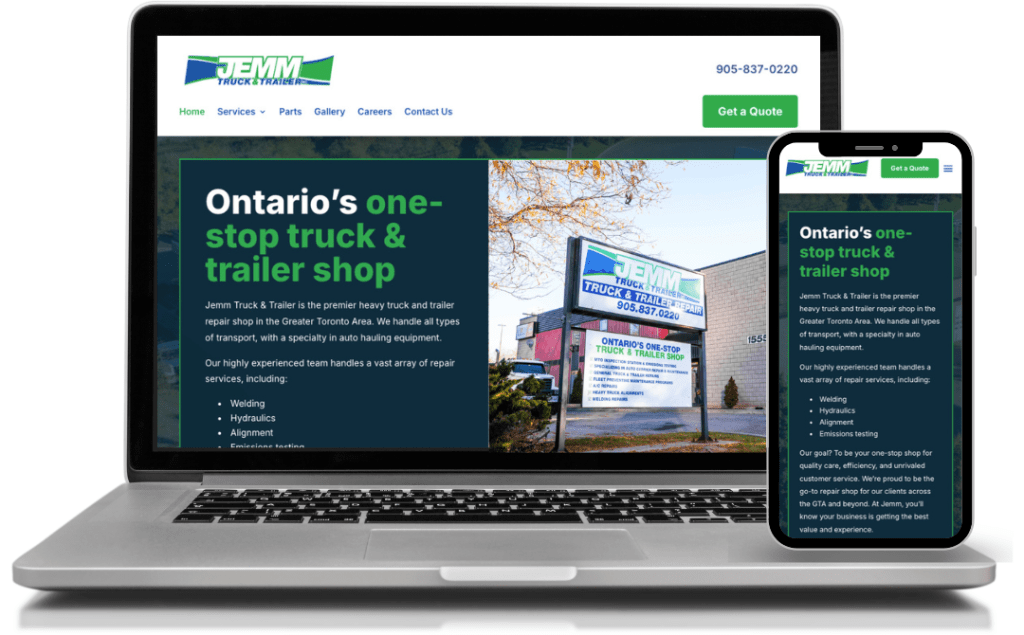
- Goal: Redesign and modernize the website to better showcase services, improve lead generation, and create a stronger digital presence for truck and trailer repair solutions.
- Role: Designer + Developer
- Tech stack / platform: WordPress
My Approach & Strategy
Understanding the Brand & Audience
I began by analyzing JEMM Truck & Trailer’s business, focusing on their core services: truck repair, trailer maintenance, inspections, and roadside support.
I identified their primary audience:
- Fleet managers
- Truck drivers / owner-operators
- Logistics and transportation companies
I evaluated the existing website and brand presence:
- Strengths: Strong industry expertise, clear service offering, local reputation
- Weaknesses: Outdated design, limited UX structure, unclear calls-to-action
Information Architecture & Content Strategy
I restructured the site to make services easier to understand and access.
Key decisions included:
- Creating dedicated service pages (Repairs, Maintenance, Inspections, etc.)
- Highlighting key value propositions (fast service, reliability, expertise)
- Building a clear sitemap with strong CTAs like “Request Service” and “Contact Us”
I ensured content was:
- Straightforward and easy to scan
- Focused on customer needs and urgency (especially for breakdown situations)
Visual Design & Branding
I modernized the visual identity while keeping it aligned with the trucking industry.
Design choices included:
- Strong, bold typography for clarity and impact
- Industrial-inspired color palette (dark tones, reds/blues, metallic accents)
- High-quality imagery of trucks, trailers, and service environments
I introduced:
- leaner layouts
- More whitespace for readability
- Consistent visual hierarchy across pages
UI / UX & Interaction Design
I focused on usability and conversion:
- Simplified navigation for quick access to services
- Prominent CTAs like “Get Service” and “Call Now”
- Designed forms that are quick and easy to complete
- Structured content sections for fast scanning (important for busy users)
I ensured:
- Mobile responsiveness (critical for drivers on the road)
- Clear service breakdowns so users quickly find what they need
Technical Implementation
I developed the site using WordPress with scalable and reusable components:
- Built flexible templates for service pages and content sections
- Integrated contact and service request forms
- Optimized performance (image compression, fast load times)
- Implemented SEO fundamentals:
- Meta tags
- Proper heading structure
- Optimized service pages for search visibility
Launch & Post-Launch
Before launch:
- Conducted full QA testing (mobile, tablet, desktop)
- Tested forms and user flows
- Verified all links and content
After launch:
- Monitored performance and engagement
- Provided guidance for future updates and scalability
Before / After & Key Differences
| Aspect | Previous Site | New Site |
|---|---|---|
| Design | Outdated, basic layout | Modern, clean, professional |
| Navigation | Limited structure | Clear service-based navigation |
| Branding | Minimal visual identity | Strong, industry-aligned branding |
| CTAs | Not prominent | Clear “Request Service” focus |
| User Flow | Unstructured | Streamlined and conversion-focused |
| Mobile Experience | Limited optimization | Fully responsive |
What I Learned & Challenges Overcome
- Designing for urgency: Users often need immediate service, so UX had to prioritize speed and clarity
- Simplifying technical services: Translating complex repair services into clear, user-friendly content
- Mobile-first thinking: Many users access the site from the road
- Balancing function + branding: Ensuring the site is both practical and visually strong
 Leila's Portfolio